
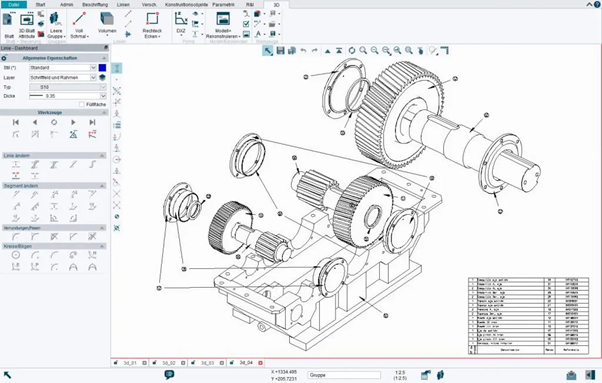
Computer-Aided Design (CAD) plays a critical role in the field of mechanical engineering. CAD is a technology that enables engineers and designers to create, modify, and analyze 2D and 3D digital models of mechanical components and systems. Here are some key aspects of CAD in mechanical engineering:
- Design and Drafting: CAD software allows mechanical engineers to create detailed and precise designs of mechanical parts and assemblies. These designs can include complex geometric shapes, dimensions, annotations, and tolerances.
- Visualization: CAD provides realistic 3D visualizations of designs, which helps engineers and stakeholders better understand the final product before it’s physically built. This aids in design validation and reduces the likelihood of errors.
- Parametric Modeling: CAD software often employs parametric modeling, where changes to one part of a design automatically update all related components and drawings. This feature streamlines the design process and ensures consistency.
- Collaboration: CAD systems facilitate collaboration among team members by allowing multiple engineers to work on the same project simultaneously. It also supports version control and revision tracking.
- Integration with CAM: CAD often integrates with Computer-Aided Manufacturing (CAM) systems, which enable engineers to generate toolpaths for CNC (Computer Numerical Control) machines directly from their CAD designs. This streamlines the manufacturing process.
- Documentation: CAD software assists in generating detailed engineering drawings, bills of materials (BOMs), and other documentation required for manufacturing and assembly.
- Customization: CAD systems can be customized to suit specific industry needs and workflows. Engineers can develop custom macros, templates, and libraries to enhance productivity.
- Cost and Time Savings: CAD significantly reduces the time and costs associated with traditional manual drafting and design processes. It also enables rapid prototyping and iterative design, leading to faster product development cycles.
Overall, CAD is an indispensable tool in modern mechanical engineering. It enhances design accuracy, reduces errors, improves collaboration, and ultimately contributes to the development of high-quality and innovative mechanical products and systems.